Meet your
breaker panel.
From incoming power
to everyday life.
See how the parts connect to the circuits you use every day. Explore your panel, understand the warning signs, and plan what comes next.
From everyday circuits to EV charging and service upgrades.
A Canadian homeowner resource from HAUSE.
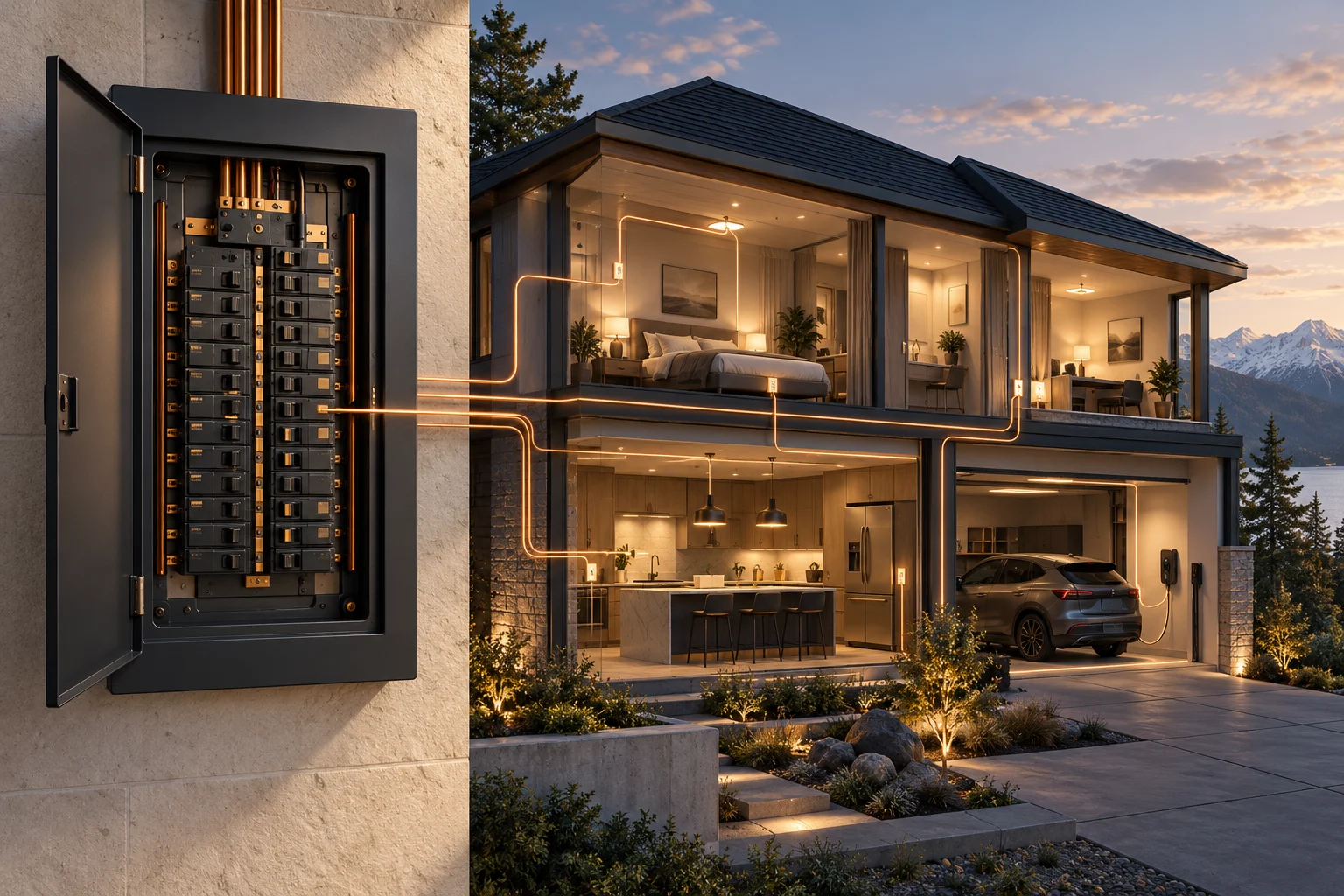
The parts behind
every circuit.
Tap a part to highlight it in the model. Each has a different job; the panel brings them together.
Main breaker — The main disconnect controls downstream supply. The service side may remain live. This model is for understanding, not field work.
From the supply
to the room.
Electricity reaches the meter, passes through service equipment, then branches into circuits for lighting, outlets and larger appliances.
When a branch breaker opens, that circuit’s path is interrupted. The rest of the home may still have power. The underlying cause needs assessment.
Understand a breaker tripA home, connected · Conceptual illustrationNormal view: the illustrated branch circuit is connected. Motion is a visual aid, not a representation of AC current or a wiring diagram.
Panel replacement
or service capacity?
Panel condition, available circuit positions and service capacity are separate questions. The best plan starts by telling them apart.
Panel replacement
Often starts with the equipment itself, circuit arrangement or the scope of a renovation.
- Documented condition or equipment concerns
- Need for circuit positions and compatible protection
- A clear record of existing and proposed circuits
Service capacity
Starts with the whole electrical system and the loads it must support.
- EV charging, electric heating or a secondary suite
- A professional load assessment and applicable rules
- Utility capacity, service equipment and management options
Homeowner
field guides.
Plain-language guides for Canadian homeowners, with specific Calgary and Alberta guidance clearly identified.
Panel replacement or service upgrade?
Separate the condition of the cabinet, room for circuits and the capacity of the supply before choosing the work.
Can your home add an EV charger?
Turn your driving and charging routine into an electrical brief before deciding whether the panel or service needs to change.
How load management changes the decision
Understand what a controller manages, how it affects everyday use and what still needs professional confirmation.
Who can replace a breaker panel?
Identify the contractor, permit holder and inspection responsibilities before the project starts.
What happens on replacement day?
Prepare for the power interruption and the professional handoffs that determine when service can return.
Recurring trips and warning signs
Describe the symptoms accurately and get the cause assessed without opening equipment or treating repeated trips as routine.
A suite changes the electrical brief
Plan the complete property, household equipment and panel access before assuming a particular service size.
Townhouses: look beyond the unit panel
A shared upstream service can change the assessment, approvals and available paths for electrification.
Water exposure: drying is not clearance
Keep cleanup, electrical equipment evaluation and authorization to restore service as separate tasks.
Compare panel quotes by scope
Make the work, assumptions and responsibilities comparable before judging the total.
Send HAUSE your
project brief.
A charger. A renovation. An older panel you want understood. Send HAUSE the basics so your inquiry starts with the right context.
Do not remove covers or approach damaged equipment to collect information. This form is for planned inquiries and is not monitored as an emergency service.
Panel questions,
answered.
Does a 200A panel mean I have a 200A service?
A panel label alone does not establish the complete service rating. The meter arrangement, service conductors, main disconnect and utility supply must support the proposed installation. Ask the electrician to identify the existing service and the work required upstream.
Can spare breaker spaces tell me how much capacity is left?
No. Circuit positions and electrical demand answer different questions. Adding the numbers printed on branch breakers also does not produce a service load calculation. An electrical professional assesses the actual loads and the applicable rules.
Does every EV charger need a service upgrade?
No. The answer depends on the existing system, charging output and household demand. Suitable load management may be an option. Ask for a comparison that includes the exact equipment, current local permit requirements and utility needs.
Can I replace the panel myself in Calgary?
The City’s homeowner permit rules exclude installing or altering the main service, including the main panel, main breaker and meter base. Arrange this work with the appropriate electrical contractor and confirm the permit and inspection responsibilities.
What should I do about repeated trips?
Record the affected area and the appliances in ordinary use, then arrange an assessment. Avoid repeated resets, larger breakers or opening the panel to investigate. Smoke, arcing, a burning smell or water exposure needs urgent attention.
Is the 3D model my actual electrical system?
The model explains the roles of common components. It is a conceptual illustration, with simplified geometry and motion; it does not identify your equipment, calculate demand or provide installation instructions.